> ## Documentation Index
> Fetch the complete documentation index at: https://narev.ai/docs/llms.txt
> Use this file to discover all available pages before exploring further.
# Reduce LLM spend by prompt engineering
> Case study: how rewriting a verbose prompt into a shorter, simpler version cut LLM costs by 24% while preserving accuracy and improving consistency.
## The scenario
You've picked the right model for your email routing task. Everything works perfectly—emails get classified correctly, routed to the right teams, and your customers are happy.
But then you notice something interesting in your logs: you're spending more on input tokens than output tokens.
The question worth asking is: **does your prompt need to be that long?**
This is a very simple example illustrating the mechanism of A/B testing for LLMs. If you're after something more
complex, check the other guides.
## The hypothesis
Many developers write verbose, detailed prompts thinking more context equals better results. But for straightforward tasks like email classification, a shorter prompt might work just as well.
Every word in your system prompt costs money—it's sent with every single request.
So there's a good chance that a concise, direct prompt could deliver the same accuracy while cutting costs by reducing input tokens.
But hunches aren't enough, let's test this hypothesis.
## Test configuration
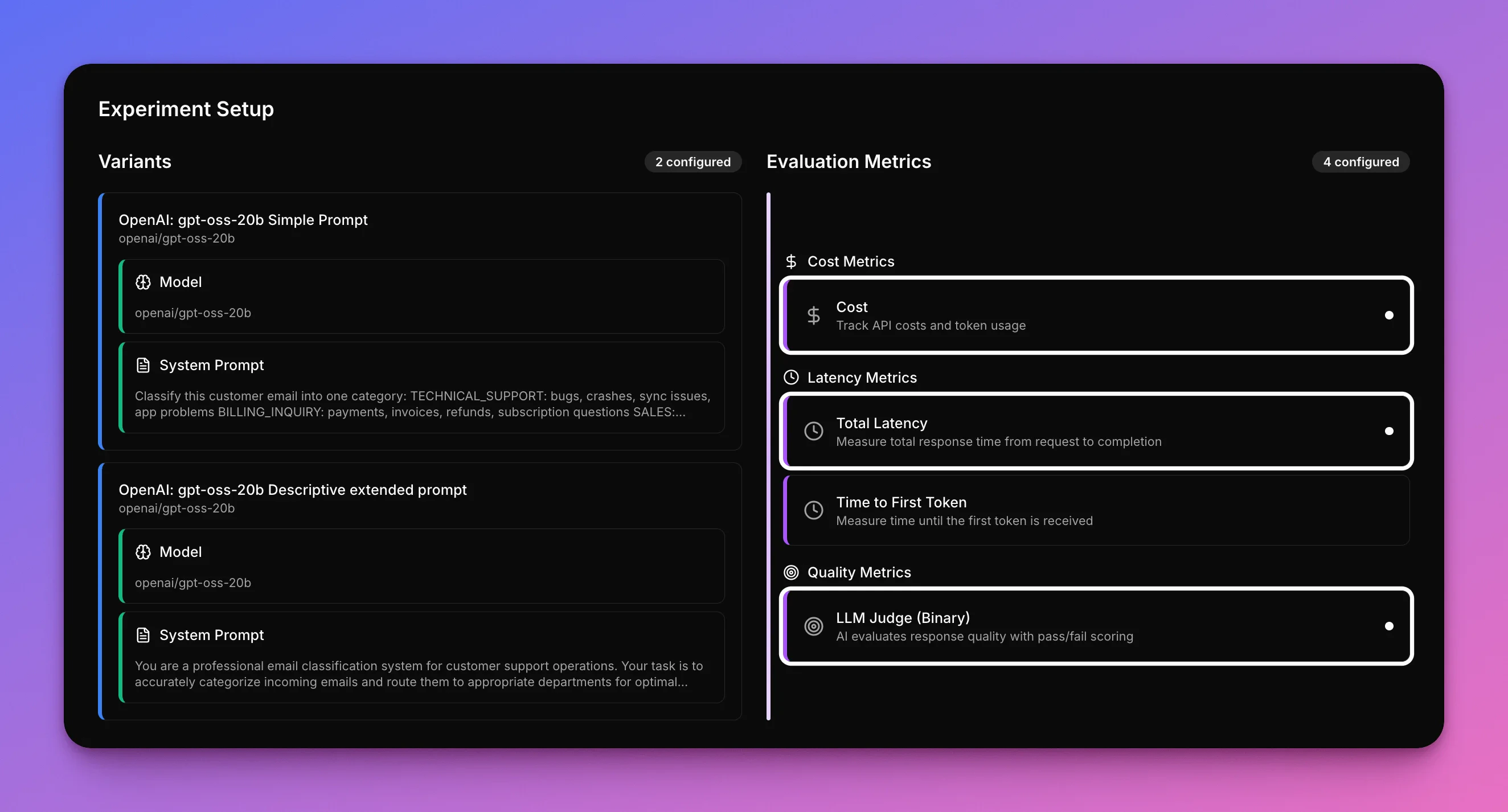
This example shows a side-by-side comparison using the Narev Platform, testing two different prompts using the same model (`gpt-oss-20b`) on identical customer emails.
The only variable? The prompt style.
This creates a clean way to see how prompt length affects cost, speed, and accuracy.
 ### Prompts tested
**Concise Prompt (225 tokens average):**
```
Classify this customer email into one category:
TECHNICAL_SUPPORT: bugs, crashes, sync issues, app problems
BILLING_INQUIRY: payments, invoices, refunds, subscription questions
SALES: demos, pricing, partnerships, new customer inquiries
Route to: mobile dev team, billing team, sales team, or escalation team
Respond in JSON:
{"category": "", "department": ""}
```
**Verbose Prompt (443 tokens average):**
```
You are a professional email classification system for customer support operations.
Your task is to accurately categorize incoming emails and route them to appropriate
departments for optimal response times and customer satisfaction.
CLASSIFICATION CATEGORIES:
1. TECHNICAL_SUPPORT:
- Application bugs, crashes, freezing, performance issues
- Installation difficulties, setup problems, configuration errors
- Device compatibility, sync failures, API integration issues
- Feature malfunctions, UI problems, connectivity errors
2. BILLING_INQUIRY:
- Invoice questions, payment disputes, refund requests
- Subscription changes, billing cycles, pricing inquiries
- Account management, payment method updates
- Tax questions, international billing concerns
3. SALES:
- Product demonstrations, pricing information, quote requests
- Partnership inquiries, competitive evaluations
- Implementation planning, volume licensing discussions
- New customer onboarding, trial requests
ROUTING GUIDELINES
Technical issues should be directed to the mobile dev team (for mobile app problems),
or the escalation team (for critical outages). Billing matters go to the billing team.
Sales inquiries route to the sales team.
ANALYSIS PROCESS
Carefully examine the email subject and content for key indicators. Consider the
sender's business context, urgency level, and specific terminology used. Look for
technical keywords, financial references, or sales-related language to determine
proper classification.
Please provide your classification as a JSON response with "category" and
"department" fields only.
```
### What gets measured
The test tracks three critical metrics for each prompt:
* the **cost per request** (shorter prompts = fewer input tokens = lower costs)
* the **speed of classification** (measured by time to first token)
* the **accuracy of the routing decisions** (cheaper is only worth it if it still works)
## Results
The results reveal something surprising: the verbose, "professional" prompt doesn't just fail to improve accuracy—it's actually worse on every metric.
Both prompts achieve 100% accuracy on the test emails, but the concise prompt uses nearly half the input tokens and responds faster.
The verbose prompt's extra context and formatting doesn't add value—it just burns tokens and slows things down.
### Prompts tested
**Concise Prompt (225 tokens average):**
```
Classify this customer email into one category:
TECHNICAL_SUPPORT: bugs, crashes, sync issues, app problems
BILLING_INQUIRY: payments, invoices, refunds, subscription questions
SALES: demos, pricing, partnerships, new customer inquiries
Route to: mobile dev team, billing team, sales team, or escalation team
Respond in JSON:
{"category": "", "department": ""}
```
**Verbose Prompt (443 tokens average):**
```
You are a professional email classification system for customer support operations.
Your task is to accurately categorize incoming emails and route them to appropriate
departments for optimal response times and customer satisfaction.
CLASSIFICATION CATEGORIES:
1. TECHNICAL_SUPPORT:
- Application bugs, crashes, freezing, performance issues
- Installation difficulties, setup problems, configuration errors
- Device compatibility, sync failures, API integration issues
- Feature malfunctions, UI problems, connectivity errors
2. BILLING_INQUIRY:
- Invoice questions, payment disputes, refund requests
- Subscription changes, billing cycles, pricing inquiries
- Account management, payment method updates
- Tax questions, international billing concerns
3. SALES:
- Product demonstrations, pricing information, quote requests
- Partnership inquiries, competitive evaluations
- Implementation planning, volume licensing discussions
- New customer onboarding, trial requests
ROUTING GUIDELINES
Technical issues should be directed to the mobile dev team (for mobile app problems),
or the escalation team (for critical outages). Billing matters go to the billing team.
Sales inquiries route to the sales team.
ANALYSIS PROCESS
Carefully examine the email subject and content for key indicators. Consider the
sender's business context, urgency level, and specific terminology used. Look for
technical keywords, financial references, or sales-related language to determine
proper classification.
Please provide your classification as a JSON response with "category" and
"department" fields only.
```
### What gets measured
The test tracks three critical metrics for each prompt:
* the **cost per request** (shorter prompts = fewer input tokens = lower costs)
* the **speed of classification** (measured by time to first token)
* the **accuracy of the routing decisions** (cheaper is only worth it if it still works)
## Results
The results reveal something surprising: the verbose, "professional" prompt doesn't just fail to improve accuracy—it's actually worse on every metric.
Both prompts achieve 100% accuracy on the test emails, but the concise prompt uses nearly half the input tokens and responds faster.
The verbose prompt's extra context and formatting doesn't add value—it just burns tokens and slows things down.
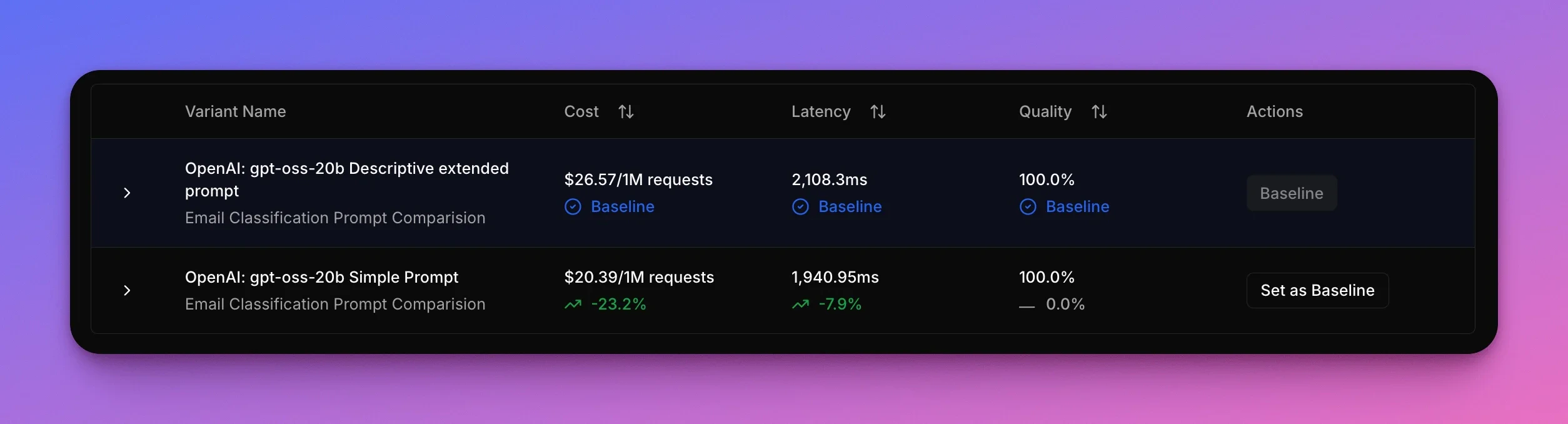 | Prompt Style | Cost (avg) | Speed (avg) | Accuracy |
| ------------- | --------------------- | ------------------ | -------- |
| Verbose | \$26.57/1M | 2,108 ms | 100% |
| **Concise** ✅ | **\$20.39/1M (-23%)** | **1,941 ms (-8%)** | **100%** |
### Winner for this test
The concise prompt wins decisively. It saves \$6.18 per million requests (a 23% reduction) and responds 167 ms faster per request (8% faster) while maintaining 100% accuracy. There's no tradeoff here—the simpler prompt is better in every way. The verbose prompt's detailed categorization guidelines and analysis instructions don't just waste money, they also slow down inference.
## Example in action
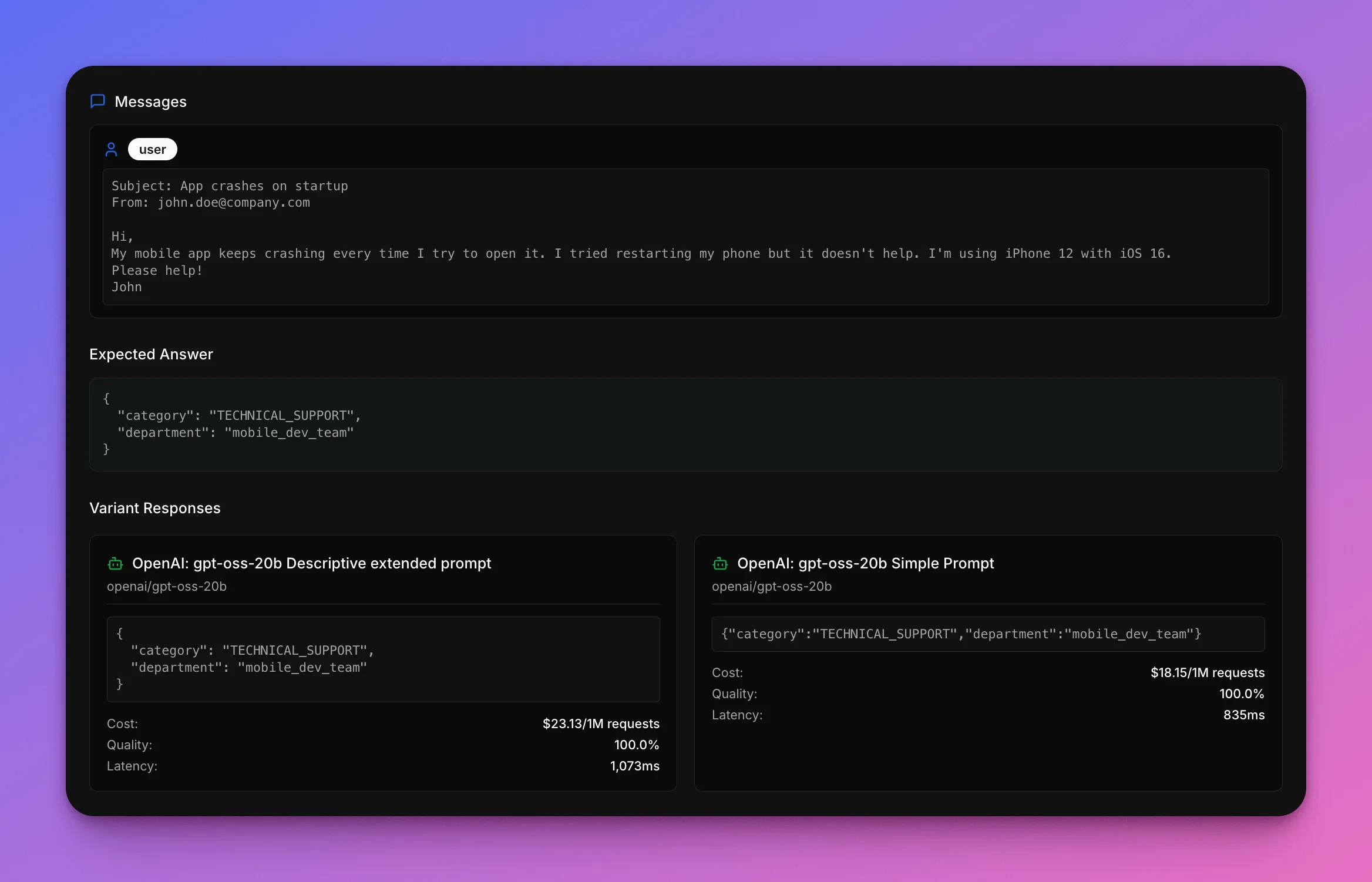
Look at how the prompts handle a typical sales inquiry. This is the kind of email that should be an easy win: clear enterprise sales intent, multiple specific questions, and an explicit request for a demo.
**Subject:** Enterprise plan pricing\
**From:** [cto@fastgrowth.io](mailto:cto@fastgrowth.io)
Hi there,
A 200-person company is looking to upgrade from its current solution. Could you send information about:
* Enterprise plan features
* Volume discounts
* Implementation timeline
* API rate limits
A demo is also requested for next week.
Thanks,\
Mike Chen, CTO
**Should route to:** `Sales team`
### How each prompt did
| Prompt Style | Got it right? |
| ------------ | ------------- |
| Verbose | ✅ Yes |
| **Concise** | ✅ **Yes** |
Good news: both prompts correctly route this email to sales. This example demonstrates that for straightforward cases (which make up the majority of customer emails), the concise prompt performs just as accurately. The verbose prompt's detailed categorization guidelines and analysis instructions don't add value—they just burn tokens and slow down inference.
| Prompt Style | Cost (avg) | Speed (avg) | Accuracy |
| ------------- | --------------------- | ------------------ | -------- |
| Verbose | \$26.57/1M | 2,108 ms | 100% |
| **Concise** ✅ | **\$20.39/1M (-23%)** | **1,941 ms (-8%)** | **100%** |
### Winner for this test
The concise prompt wins decisively. It saves \$6.18 per million requests (a 23% reduction) and responds 167 ms faster per request (8% faster) while maintaining 100% accuracy. There's no tradeoff here—the simpler prompt is better in every way. The verbose prompt's detailed categorization guidelines and analysis instructions don't just waste money, they also slow down inference.
## Example in action
Look at how the prompts handle a typical sales inquiry. This is the kind of email that should be an easy win: clear enterprise sales intent, multiple specific questions, and an explicit request for a demo.
**Subject:** Enterprise plan pricing\
**From:** [cto@fastgrowth.io](mailto:cto@fastgrowth.io)
Hi there,
A 200-person company is looking to upgrade from its current solution. Could you send information about:
* Enterprise plan features
* Volume discounts
* Implementation timeline
* API rate limits
A demo is also requested for next week.
Thanks,\
Mike Chen, CTO
**Should route to:** `Sales team`
### How each prompt did
| Prompt Style | Got it right? |
| ------------ | ------------- |
| Verbose | ✅ Yes |
| **Concise** | ✅ **Yes** |
Good news: both prompts correctly route this email to sales. This example demonstrates that for straightforward cases (which make up the majority of customer emails), the concise prompt performs just as accurately. The verbose prompt's detailed categorization guidelines and analysis instructions don't add value—they just burn tokens and slow down inference.
 ## What this shows
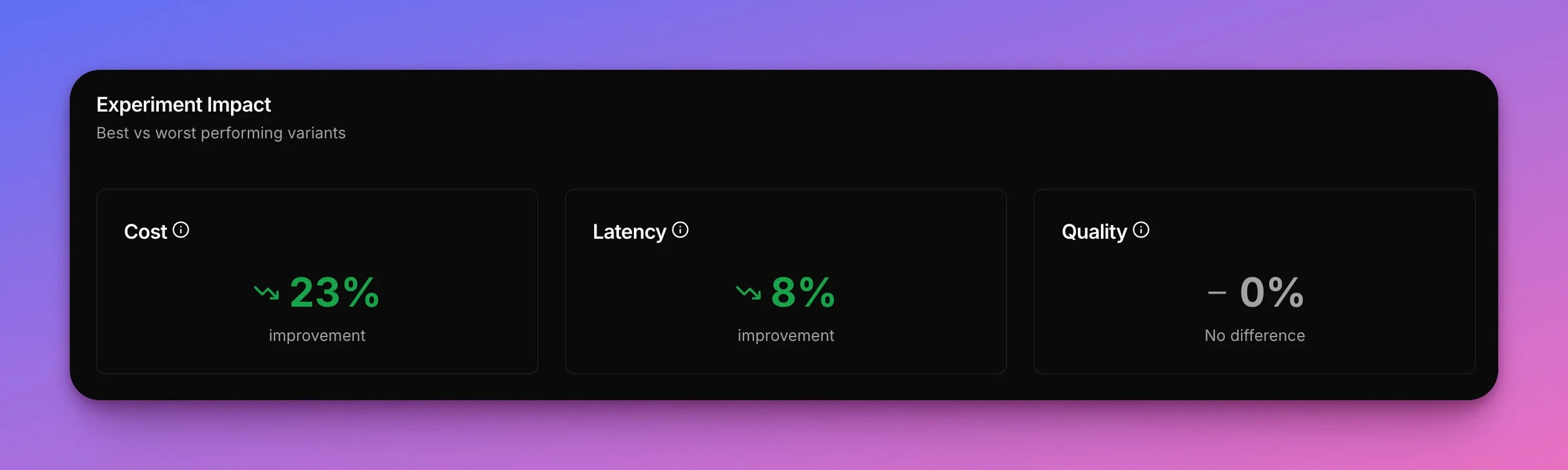
Prompt verbosity doesn't equal better results. For straightforward tasks like email classification, a **concise prompt is 23% cheaper and 8% faster** while maintaining **100% accuracy**.
You don't have to compromise anything. The simpler prompt wins on **cost, speed, and quality**—perfect classification that costs less and responds faster on every single request.
## The takeaway
Using a **concise prompt saves $6.18 per million emails** (23% cost reduction) and **responds 167 ms faster** (8% speed improvement) while maintaining **100% accuracy**. Pay **$20.39** instead of **\$26.57** per million requests.
## What this shows
Prompt verbosity doesn't equal better results. For straightforward tasks like email classification, a **concise prompt is 23% cheaper and 8% faster** while maintaining **100% accuracy**.
You don't have to compromise anything. The simpler prompt wins on **cost, speed, and quality**—perfect classification that costs less and responds faster on every single request.
## The takeaway
Using a **concise prompt saves $6.18 per million emails** (23% cost reduction) and **responds 167 ms faster** (8% speed improvement) while maintaining **100% accuracy**. Pay **$20.39** instead of **\$26.57** per million requests.
 There's no reason to use the verbose prompt. The **concise prompt wins on every metric**: lower costs, faster responses, and the same perfect accuracy. The savings and speed improvements compound with every single API call.
***
Want to test which prompt works best for your use case? [Start testing for free →](https://narev.ai/login)
There's no reason to use the verbose prompt. The **concise prompt wins on every metric**: lower costs, faster responses, and the same perfect accuracy. The savings and speed improvements compound with every single API call.
***
Want to test which prompt works best for your use case? [Start testing for free →](https://narev.ai/login)